Most brands plan influencer payments as a single line in the budget. Sign the creator, send the money, close the tab. The real path from a signed contract to cash in a creator's bank runs through five checkpoints, and each one is where budgets leak, creators go quiet, and your best partners stop replying. Gigapay tracked the workflow and found manual payment operations eat about 840 hours a year at 600 collaborations, or 1.4 hours per creator before a dollar moves.
Influencer payments break at five points you don't see
A payment runs as a relay across several hands. Gigapay lays out four checkpoints brands move through: contract, deliverable approval, invoicing, and finance review. Add cross-border tax filing and you have a fifth. Every handoff is a place where the money stalls.
- Contract signed and scoped to a defined deliverable.
- Creator delivers, brand approves the content.
- Creator sends an invoice with legal name and tax details.
- Finance reviews, often on Net-30 or Net-60 terms.
- Payout clears, minus bank fees and currency spread.
Net-60 is the most expensive line in your contract
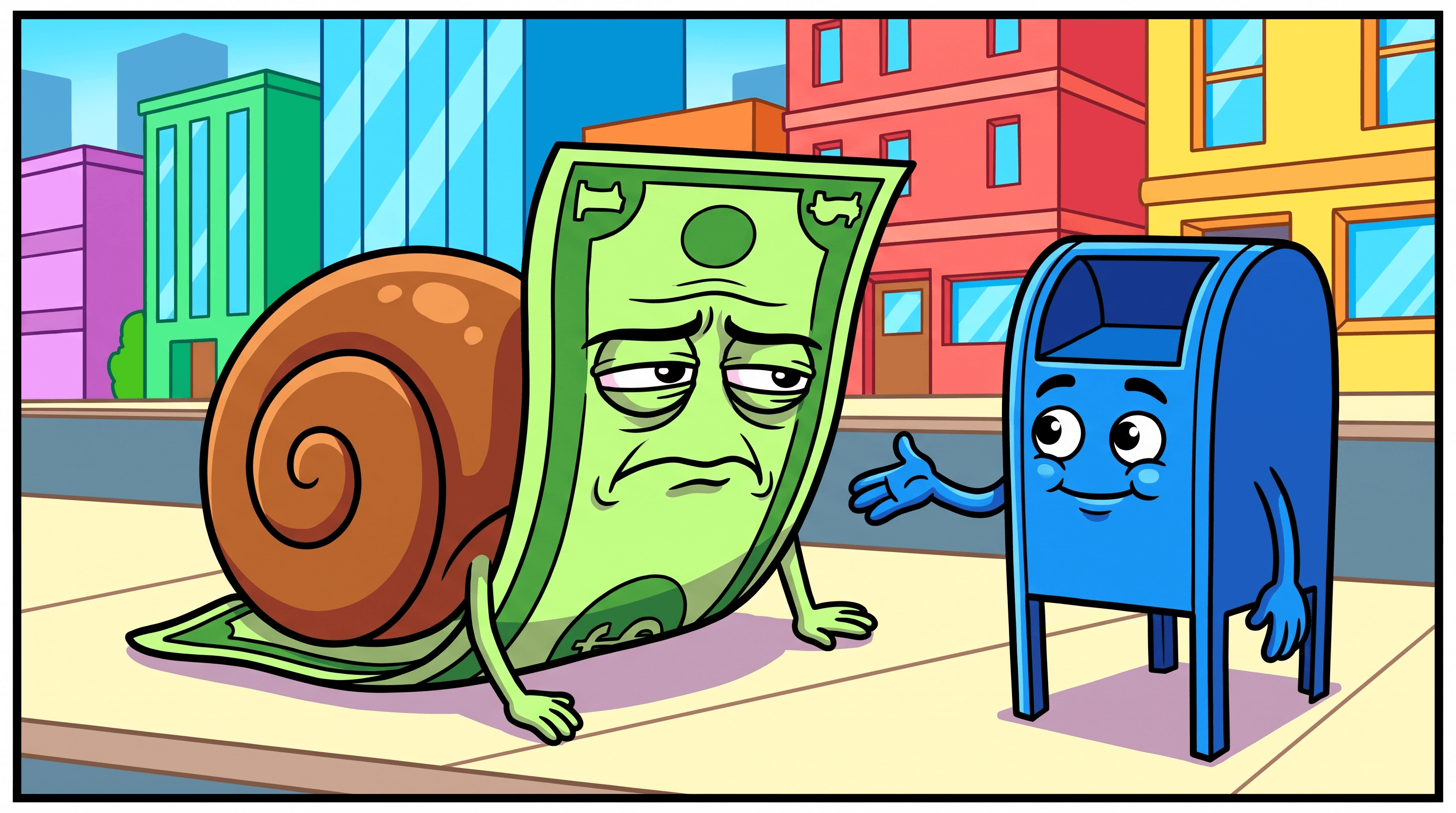
Slow payment does not save you cash. It costs you the creators worth keeping. Gigapay reports payment delays of up to 120 days across the creator economy in 2026, and Sprout Social notes Net-30 and Net-60 are still the default. A creator who waits four months for a $400 fee remembers it, and the next time you brief them they quote higher or pass.
Do the math on a small program. Ten creators at $400 each is $4,000 out the door. If three of them walk after a 120 day wait and you re-source at $450, you spend $150 more plus the hours to find replacements. Late payment shifts the spend to a line you were not watching, at a higher total.
Paying influencers: your method decides what they receive
The method you pick changes the number that lands. Influencerfee lists the common routes: ACH or wire for US creators, PayPal for international and marketplace deals, and platform processed payouts. Each one takes a different cut and runs at a different speed.
| Method | What it costs | How fast | Tax paperwork |
|---|---|---|---|
| PayPal | 2.9% plus a fixed fee per transfer, and about a 3% currency spread on international | Minutes to a few days | Creator handles it, brand keeps the invoice |
| Wire or ACH | Bank fees from $0 to $45, no platform cut | 1 to 4 business days | W-9 or W-8BEN required first |
| Platform or merchant of record | One consolidated invoice, no per-creator wires | Set by the campaign trigger | Vendor files the reporting |
Run the conversion math on a $500 payment to a creator in another country. A 3% currency spread removes $15 before they see it, and PayPal's fixed fee takes another $0.30. That is $15.30 gone on a single transfer, and the creator feels it as a $484.70 payday for work they priced at $500. Gigapay notes a merchant of record model folds hundreds of creators into one vendor and one invoice, which removes the per-transfer fixed fees.
Cross-border payouts turn one invoice into five problems
Pay a creator outside the US and the paperwork multiplies. US based creators file a W-9 before payment. Non-US creators file a W-8BEN. Gigapay notes cross-border payouts can trigger DAC7, KSK, KU14, and 1099 reporting across dozens of jurisdictions. Most brands collect these forms by hand, one email at a time, and that is where campaigns stall.
A beauty brand running 50 creators across 11 countries was losing close to a week per batch just collecting W-8BENs and reconciling currencies. On UGCBloom, the brand funds one campaign balance and the platform pays each creator in their own local currency with no manual transfer, while a signed contract holds the budget in escrow and a unique promo code attributes each sale back to the creator who drove it.
Start your first campaign today
Brief creators, collect videos, and track performance in one place.
A signed contract and escrow beat a friendly DM
A contract is the switch that lets money move. It gates video submission, sets the payment timing, and holds the budget until the work is live. Our influencer contract template breaks down the three clauses that matter and the seven that do not. Without it, every payout becomes a fresh negotiation.
When a creator posts approved content, the money has to follow without a new approval loop. On UGCBloom, a person on the brand side approves the creative, and the platform releases payment from the funded balance on the trigger the campaign set, such as pay per approved video or per conversion, so no one builds a payment link by hand. The flat fee versus performance math still decides the number, but the release is automatic.
Influencer cash payment proof: what counts as a record
Paying an influencer in cash, or by a transfer agreed in a DM, leaves both sides without proof of what was paid and for what. If the payment is ever questioned, by your finance team, an auditor, a tax authority or the creator, you need a paper trail that ties the money to a deliverable. Four records do that:
- A signed contract naming the deliverable, the fee and the payment trigger.
- The creator’s invoice with legal name, amount and tax details.
- A bank, PayPal or platform transfer record whose amount and date match the invoice.
- The creator’s tax form on file: a W-9 for US creators, a W-8BEN for non-US creators.
A cash handoff produces none of these, and a screenshot of a DM saying “paid” is not a receipt. If a creator insists on cash, get a signed, dated receipt that names the contract and the amount, and treat it as the exception, not the process.
What a 120-day delay costs your next campaign
Here is where the model breaks down for small teams. The 840 admin hours Gigapay measured assume 600 collaborations a year. At 50 collaborations, that is still 70 hours of pure payment wrangling, almost two full work weeks, spent on transfers and forms instead of briefs. Fast, consolidated payouts decide whether you run 50 creators or 20. The hours saved go straight back into briefs and sourcing.
The fix is boring and it works: pick one payment path, collect tax forms up front, put the rate and trigger in a signed contract, and pay on a date you would accept yourself. Creators talk. The brands that pay on time get first replies, better rates, and the creators who convert.
Open your last ten paid collaborations and count the creators who waited more than 30 days for money. If the number is more than two, your payment terms are the real bottleneck on the program.
Try UGCBloom
Launch authentic creator video campaigns and track every result in one place.